Asynchronous healthcare has exploded across the UK in the past decade. The majority of the public are aware that they can get care online. This is largely a great development for patients, as research has shown it vastly improves accessibility to treatment. However, what do we know about how safe and effective it is? There is already some data available to help us answer this.
Multiple systematic reviews and comparative studies from 2023–2025 show that asynchronous consultations can be effective for diagnosing and managing simple health issues in primary care, often referred to by the NHS as minor illnesses (e.g., coughs, sore throats, or urinary tract infections). In these studies: [1][2]
- Up to 58% of patients received prescriptions after an asynchronous consultation, with antibiotic prescribing more often in line with national guidelines than in face-to-face visits. [1][3]
- Between 33–66% of patients reported their issue resolved via asynchronous means, with complete resolution more likely than through traditional consultations in some cases. [1]
- Clinicians judged between 55–88% of asynchronous consultations to be feasible replacements for face-to-face interactions, depending on the complexity of the presenting problem. [1]
Asynchronous systems have been especially successful for straightforward, low-risk, self-limiting medical issues. However, more complex or ambiguous presentations often required follow-up through telephone or in-person assessments, limiting potential efficiency gains. [1][2][4]
Studies evaluating quality across domains such as safety, timeliness, and patient-centredness suggest:
- No significant difference in hospital admissions or adverse outcomes compared with other consultation types. [1]
- Faster symptom resolution and shorter turnaround times due to 24/7 platform access.[1]
- Higher convenience and satisfaction, as patients could consult without travel and complete assessments asynchronously, often saving an hour or more per episode. [1][5]
We wanted to see if we could expand on the available data to get a more detailed look at how patients responded to our delivery of asynchronous care. Over the past contact cycle, Evaro reached out to 208,688 patients across five of our popular treatment areas: weight loss, erectile dysfunction (ED), dental infection, asthma, and urinary tract infection (UTI) with a comprehensive post care questionaire. We wanted to understand not just whether async care is convenient, but whether it is safe and effective. This is what we found, and where we think the model still needs to improve.
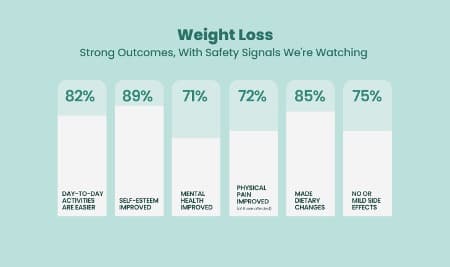
Weight Loss: Strong Outcomes, With Safety Signals We're Watching
A total of 29,185 weight loss patients were contacted using injectable GLP1 treatment from our service.
- 80% are satisfied with their progress, and 43% have lost 10% or more of their starting body weight.
- The benefits extend well beyond the scale: 89% report improved self-esteem, 82% say everyday physical activity has gotten easier, and 71% report better mental health.
- Side effects were manageable for the large majority. A very small cohort — 16 patients reported out of the 29,185 contacted — experienced side effects requiring clinical follow-up. This is a safety signal we monitor closely, and one of the reasons clinical oversight stays central to how we deliver this treatment async.
- The main challenge isn't the treatment — it's habit change. 33% are struggling to maintain dietary adjustments, which tells us aftercare support, not the medication itself, is where the next improvement needs to happen. This highlights the need for more education around dietary and exercise habits, which would drive real long lasting change.
Erectile Dysfunction: The Highest-Stakes Stat Is Access, Not Side Effects
We contacted a total of 18,421 patients using erectile dysfunction medication from our service. This only included treatment with tablets, not with injectables.
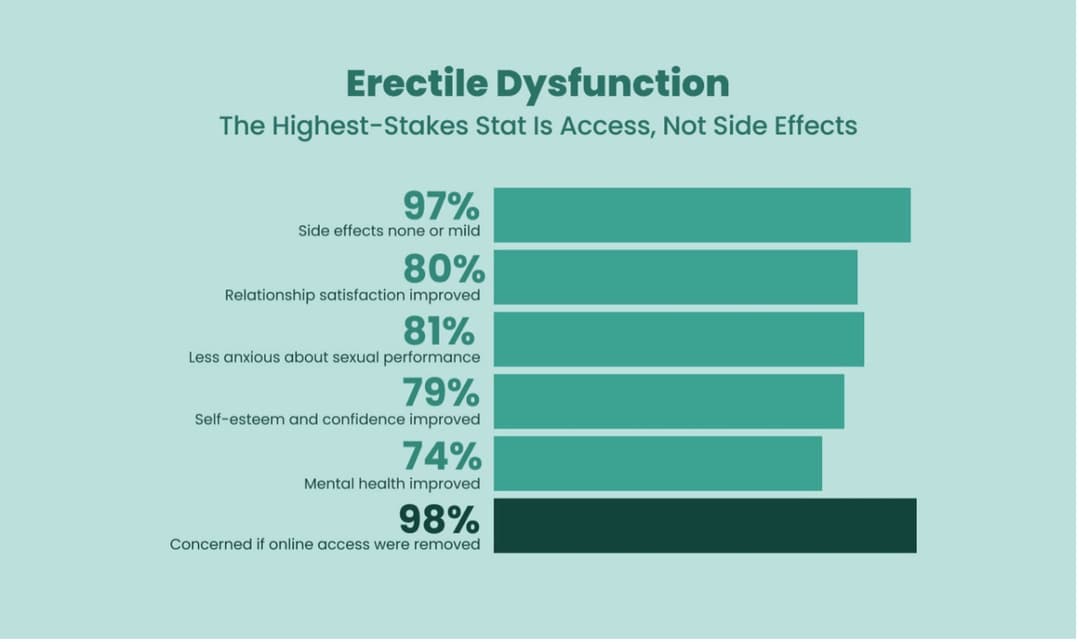
- 88% are satisfied or very satisfied with treatment, and 99% experienced no or only mild side effects.
- The psychological and relational impact is the real headline: 81% feel less anxious about sexual performance,80% report improved relationship satisfaction, 79% report improved self-esteem, and 74% report improved mental health.
- 98% said they'd be concerned if they could no longer access ED medication online — the highest online-access dependency of any area we studied. For this group, async care isn't a convenience layer on top of existing access; for many, it likely is the access.
- Two patients exceeded the maximum recommended dose and required clinical follow-up — a small number, but worth noting and a potential for better education for patients.
Dental Infection: Fast Relief, But a Follow-Up Care Gap
We contacted the biggest number of patients in this study, a total of 59,175 patients who received acute treatment for dental infection. All patients were signposted to their dentist after any antibiotic treatment to treat the underlying condition of their infection.
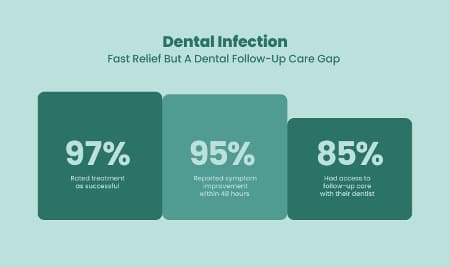
- 97% rated treatment as very successful, and 95% reported symptom improvement within 48 hours.
- Side effects were rare: only 9 patients (3%) reported any, all mild and within the common category for the medication.
- 95% said online access reduced their stress or anxiety — for an acutely painful condition, speed of access is itself a clinical and wellbeing benefit.
- The gap that matters: 15% can't get a follow-up dentist appointment, and 56% haven't taken probiotics after their antibiotic course.
Async care solved the acute problem fast, however the systems around it has not caught up sufficiently. Patients still struggle to get into their dentist, even after the acute infection stage. This highlights the need for more robust dental care, and cutting down on waiting times.
Asthma: Mostly Controlled, Glad to be Async But With More Education Needed
We contacted 57,028 patients who recently received care for their asthma from our service.
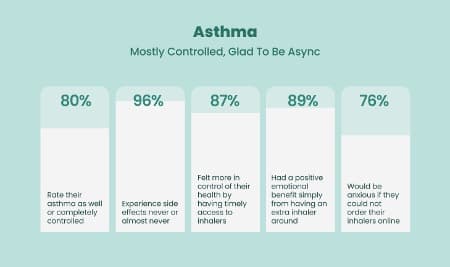
80% rate their asthma as well or completely controlled, and 96% experience side effects never or almost never
- 87% say timely online access made them feel more in control of their health.
- 25% don't clearly know the warning signs of worsening asthma — an education gap, not a treatment failure.
- On switching to combination inhalers, patients are more willing than resistant (48% vs 29%), and the resistance that exists is mostly attitudinal rather than clinically driven — which suggests better communication, not better medicine, is the lever to pull.
- 87% felt more in control of their health by having timely access to inhalers, and 89% had a positive emotional benefit simply from having an extra inhaler around. 76% Would be anxious if they could not order their inhalers online. This highlights the need for asynchronous care in this segment and the potential failings of the traditional GP systems.
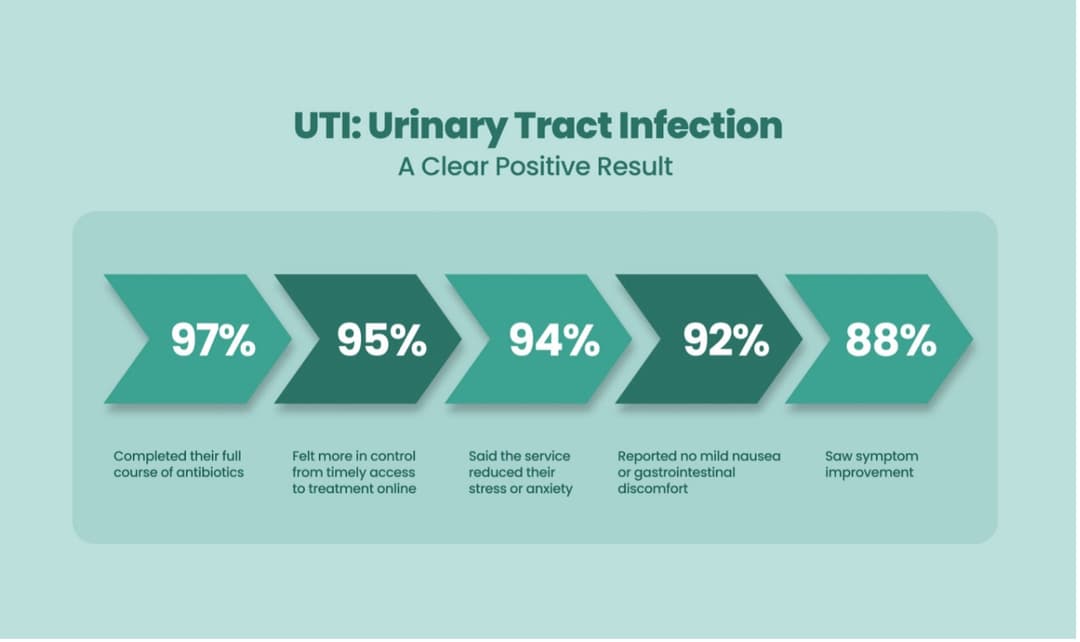
UTI: Urinary Tract Infection, A Clear Positive Result
This cohort size was 44,879, consisting of female patients using our service to treat uncomplicated UTI.
- 88% saw symptom improvement, and roughly 97% completed their full course of antibiotics — a strong adherence result, especially relevant given antibiotic stewardship is a live clinical and policy concern.
- Side effects were reported by 8%, mostly mild nausea or gastrointestinal discomfort.
- 94% said the service reduced their stress or anxiety and 95% felt more in control from timely access to treatment online.
- Only 49% took probiotics after treatment.
The Pattern Across All Five Areas
Strip away the treatment-specific granular details and three things hold true:
- Patients getting async treatment are, overwhelmingly, satisfied and safe. Side effects are rare and mostly mild; satisfaction sits between 80–97% across all treatment areas.
- The benefit isn't just clinical — it's psychological. Reduced anxiety, improved self-esteem, and a sense of control show up as consistently as the treatment outcomes themselves. Async care isn't succeeding despite removing the in-person visit; for many patients, the removal of friction is itself part of the benefit.
- Where async care falls short, it's the system around it — not the treatment. Diet support, dental follow-up access, asthma education, and the handful of safety signals we flagged above are not arguments against the model. They're the roadmap for what async care needs next: better-connected aftercare, not less digital access.
That third point is the one we want policymakers to sit with. The conversation in digital health regulation often treats "online" and "safe" as a tension to be managed. Our data suggests the more useful question is different: not whether async care is safe, but what infrastructure makes it safer. Better follow-up referral pathways, clearer red-flag education, and continued clinical monitoring of the rare cases where things go wrong.
Where We Go From Here
This is the first time Evaro has put its outcome data out in public. It won't be the last. We're publishing this because patients are getting good outcomes from async care and, until now, no one was telling that story with real numbers attached. We think the regulators and policymakers shaping the future of digital health deserve to see it, strengths, gaps, and all.
We'll be back with the next instalment of this evidence base soon.

Dr Oskar Wenbar
The chief medical officer and cofounder at Evaro, an online prescribing platform in the UK. He holds a Masters degree in Pharmacy and PhD in medicine and is a published researcher in the field of aging and longevity.